Care of Indian black Turtle (Melanochelys Trijuga)

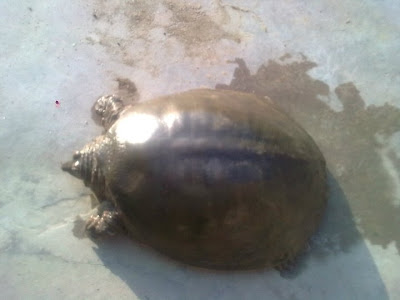
This is a medium‑sized freshwater turtle commonly found in Asian river systems. Despite its name, the colour of its upper shell (carapace) varies quite a bit, from reddish to dark brown and even black, usually with yellow streaks running along its length. The underside (plastron) is uniformly brown.
The face often has yellow or orange marks and spots, with the exact pattern varying between sub‑species. In the Asian region, six sub‑species have been identified, each with somewhat different spot patterns on the head. Adults typically measure around 38–45 cm in length.
There isn’t a lot of detailed care information available online for this species, so in this guide I’ve combined my own experience with whatever reliable information I could find, to help you keep this turtle successfully in Indian conditions.
Enclosure and Tank Setup
For a basic idea of its enclosure when keeping it as a pet, please refer to the sketch below. The sketch shows the essential elements of a good turtle tank and is useful for understanding the basic tank requirements and layout.
In an indoor tank setup, you will need:
Substrate (sand or fine gravel, ideally)
A strong filtration system (external canister filters are usually best)
A water heater if you live in a colder area
A solid platform for basking
A basking light above the platform
Decorations are optional and depend on your taste, but always make sure they do not have sharp edges or narrow gaps where the turtle can get stuck or injured.
If you have an outdoor pond, that is even better. Based on my experience, this species prefers:
Slow‑flowing or gently moving water
Sandy substrate in tanks
Mud/soil substrate in outdoor ponds
It likes to rest and move over soft bottoms, so sand or mud works much better than bare glass or very sharp stones.
Don’t forget to look at the enclosure sketch below to understand how all these elements (water area, basking platform, light, filter inlet and outlet) fit together in a practical layout.
Diet: Omnivorous Feeder
This turtle is omnivorous, meaning it eats both animal and plant matter. In and around natural habitats, it will feed on:
Aquatic vegetation
Small fish
Snails
Aquatic insects
In captivity, you can offer:
Aquatic plants from local fish shops (often cheap and sold for planted aquariums)
Collected aquatic plants from clean ponds and streams (only if you’re sure the water is not polluted)
Feeder fish occasionally
Snails and insects from safe sources
I used to visit a nearby river, catch some aquatic insects and bring them back as live natural food for my turtle. This kind of live feeding stimulates natural hunting behaviour and keeps them active.
Since I brought mine when it was small, I also acclimatised it to artificial food slowly, by mixing commercial pellets or turtle sticks with natural items. Over time, it began accepting some of the prepared food as well.
This species is most active during early morning and evening, so those are the best times to feed and observe behaviour.
Breeding Behaviour
Although I was not able to successfully breed this species myself, I’ll share the breeding‑related observations and information I have.
Breeding usually occurs during the monsoon season.
During this time, males become more aggressive and actively chase females.
Mating involves the male attaching himself on top of the female in the water.
After successful mating:
The female looks for a sandy or muddy area alongside the enclosure or pond, in a warm, sunny spot.
She burrows a nest in the sand or mud.
Around 8–10 eggs are laid in the nest.
The eggs are incubated for roughly 60–65 days.
The babies usually hatch around the summer season.
If you are trying to breed this turtle in captivity:
Provide a proper nesting area with dry, firm but diggable sand or sandy mud above water level.
Make sure the female can easily climb out of the pond or tank to reach this nesting zone.
Avoid disturbing the nest once eggs are laid, and protect it from predators and flooding.
This medium‑sized freshwater turtle is an interesting species to keep, especially in Indian conditions where slow rivers and ponds are common. With a tank or pond that matches its love for slow water and soft substrate, a mixed omnivorous diet, and some understanding of its breeding season, you can give it a stable and healthy home.


what to do if it does not eat at all during summer days?
ReplyDeleteHe deserves to be in a pressure cooker then
ReplyDeleteu deserve to be in a pressure cooker fool
DeleteWhat type of foods
ReplyDeleteCarrots grapes banana palak cabbage prawns dry fish chicken liver
DeleteYou have copied pasted Wikipedia. Good work. Atleast reply to people asking questions
ReplyDeleteI have baby Indian black turtle I buy defferent type company of food to give her because nowadays she don't eat only hiding in a cool & dark place & sleeping 😭
DeleteYou have copied pasted Wikipedia. Good work. Atleast reply to people asking questions
ReplyDeleteHow often should I give my turtle food
ReplyDeletedont give food
DeleteWhat to feed the black turtle, please let me know clearly
ReplyDeleteIn addition to these, pet stores can also provide pet owners with the best tools that can help them take care of their pets. dog toys
ReplyDelete